Wednesday, July 14, 2010

ATM vs. Anarchy


One of my favorite emails sent to my mother while trying to live in Bolivia:

Subject: ATM

Tried it again. I even went to my favorite ATM in the city - the machine conveniently next to la Universidad San Simón and placed above the anarchy graffiti, instructing us to "destroy and rebuild" ...
I thought since I was trying to fight The Man but still use The Man, it would show a little grace.
Alas, nada... hypocrisy is transparent.

Sunday, July 11, 2010

On the Edge of the Kingdom


The 15th anniversary of Srebrenica is today;  these strong women buried 775 Muslim men and boys this year. See "Boxing a Youtube Genocide" for my post from the anniversary last year.
The following is a piece I wrote for Jottings, the literary publication of the Mere Christianity Forum. I reflect on my experiences in the wake of war. Where others seem to lose God, I found Him/Her in the Valley of the Shadow of Death. 
Though I walk through the valley
of the shadow of death,
I will fear no evil
Psalm 23:4


My Jottings submission: 


I was ready. I had no choice. I had to go in prepared, rehearsed and researched. Three visits to massacre sites in less than two years. Yet, this time I was alone to visit and conduct research in Srebrenica, the site of the worst European massacre since World War II.
The wake of war became shockingly casual - burned houses with naked skeletons of three story houses were familiar. I continued with my daily routine, trying to forget that the house in front of mine suffered the loss of three boys. I continued shopping for groceries even after realizing the man in the juice aisle has no left arm; then rationalizing that it was more important that was a man still alive.
I joined the 30, 000 people at the Memorial Ceremony of July 11, 2009. Fourteen years after the war ended, Srebrenica had only to bury 534 men and boys that year. They laid to rest 534 more from the over 8, 000 Muslims killed while seeking sanctuary in a UN Safe Zone. As I witnessed the line of coffins filing by me, I paid my respect with such meager offerings - my camera, my witness, this voice. I didn't break, didn't cry. I had no right to cry, I have lost nothing.
The funeral and memorial ceremony were an act of solidarity. This gave me hope because I was part of thousands who continue to remind the world that we pledged “never again” after the Holocaust. I felt the raw edges between the “Kingdom Come” and a world trying to bring the Kingdom now as we echo the mantra “never again” through Cambodia, Bosnia, Rwanda and now Darfur.
 Consequently, what scared me and moved me to tears was a video I saw on Youtube. It was recorded by a Serb soldier during the massacre; a father was yelling for his son to come down from hiding in the mountains while surrounded by soldiers that would eventually add him to a mass grave. Genocide had found Youtube, and I couldn't take it. If we can now watch people literally being marched to their grave and not react, what kind of sick game is this? When taught about the Holocaust, why are we not also taught about the concentration camps in Argentina or the 677 camps that filled Bosnia? I used to imagine my “Valley of the Shadow of Death" as natural worse case scenarios - cancer, death of a family member, or a serious accident. My Valley was quite small because I was raised in a world that gave me a perfect childhood sanitized of extreme pain. Yet, I had found a manufactured Valley of the Shadow of Death – one filled with structural violence – such war, poverty and inequality.
 As a result, I almost drowned in the face of “daily crucifixions.” For a while, I merely treaded water among questions of solidarity, suffering and my personal anger. By day I would meet concentration camp survivors and by night I would read their stories. In Sarajevo I waited in the same line to buy lunch where 16 people died in during the war*. Walking home, I knew what areas to avoid because they had yet to be de-mined. As my Valley encountered and absorbed more violence, I became polarized. How could I not only remain neutral, but also forgive people for crimes I never witnessed?
The day after the Srebrenica funeral, I heard young Serb Nationalists came into Srebrenica and yell “we will rid the Balkans of all Muslims.” How could I love these kids, younger than me, who screamed death threats the day after the community buried 534 beloved ones? All I wanted to do was vomit; I needed a concrete physical release from the disgust I felt from inside a preventable Valley of Death.

I was no longer in the shadows, I was meeting people who had survived war and lost others from preventable murder. One of the people I would encounter was Miroslav Volf, torture survivor and theologian; his work offers a transparent theology that reminds us we are called to a relationship of love, reconciliation and forgiveness. I was shown a Valley so deep and wide that it both brings me to my knees and revives me. Where others seem to lose God, I found Him/Her. It was on the edge, that I could hear God whispering the same words an Iraqi father spoke to his child: “Come back my son, come to my lap. I am your father.”  Both fathers have known intimate violence and the pain of losing their children to war.

I came to realize that the “Valley of the Shadow of Death” is supposed to be a magnificent Valley that testifies of the Kingdom. I used to consider the natural splendor a cruel exaggeration of the suffering, but now I know it is God challenging affliction. Killing fields such as Srebrenica and El Mozote are truly sacred because they are Holy Ground. It is here we feel the edges of the Kingdom; for it is in profound beauty and profound oppression that concrete theology manifests; it is an opportunity to bring the kingdom now, not just to come.

We must stop saying "Never Again” if we make this promise and then remain neutral.  "Until Next Time" is more appropriate until justice has been served and violence prevented.  If I wanted to consume information and remain neutral, I would have stayed home and googled Srebrenica. As the July 11 anniversary of Srebrenica approaches each year, I fight for “they kingdom come:” I educate myself on the current wars by complimenting mainstream media with independent sources such as Democracy Now! or Al Jazeera English (they are not embedded with American troops). I “speak truth to power” by signing petitions and notifying my representatives that there is accountability. I also offer my support to organizations such as Witness for Peace who refuse to leave the conflict zones the world seems to have abandoned.


Please start to bring the Kingdom now by signing the petition to say “Never Again” in the face of the current genocide in Darfur, Sudan.

May those who never forget remind us who try!

* 27 May 1992. Bread Line Massacre, Sarajevo, Bosnia and Herzegovina.


 Resources

 The Srebrenica Genocide Blog is constantly updating with new information.
General background information on the worst European massacre (in a UN Safe Zone) since WWII can be found here.

Monday, July 5, 2010

¡Bienvenidos a Cochabamba!


Note: I sent this as an email because I am behind on my blogging. I am still trying to publish posts from traveling in southern Africa on study abroad with Furman. But, I need to get this up, so here it is:

I promised myself I would never do an update email. I have a blog, after all. Except when your blogging as if you are still in Africa when you are very much in Bolivia. Besides, I am using a keyboard where 9 1/2 of the keys have labels taped to them. It is just too tempting...

I am in Cochabamba. Thanks to skype. Before you read any further, please go make a skype account. It is a life necessity. My flight left almost 2 hours late from Miami so in addition to listening to a two hiker´s litany of every outdoor vacation they have taken, their new gear, and the family that just ¨let them go¨I missed my flight to Cochabamba. I had to buy a visa upon arrival, 135 USD. My first taste of the progressive government of Evo Morales. He mirrored US immigration policy and consequently made American entry into the country just as expensive and complicated as we make our frontera. I was told I could fly standby at 7 pm that night, 12 hours from then. I called my school in Cochabamba and informed them I was not on the flight that should be arriving in a few minutes. The phone cut out just in time for me to hear them say go to another airline. Oh, ok. Not as an experienced traveler as I thought I was.

So, after buying 2 bottles of water to combat the altitude, (La Paz is the highest capital in the world) I went and stored my luggage. I learned that in SFO - I could lap that tiny airport free of my bag. Realizing I couldn't work the pay phone, I went to the internet cafe and called the school followed by a call to my mom. I booked a flight for 9.30 that morning and then went to get my bags back out of storage. Try conjugating verbs while clearly affected by the altitude. I could barely think in English. I called my mom back and asked her to please call Cochabamba, I couldn't miss my next flight and the cell phone number I was given wasn't working.

Round two. I go to the gate, confidant because I just bought a plane ticket in Bolivia. I was promptly told to turn around, I had to pay the national tax -paid it, went through. Not hard, I will just wait until they line up and fall in the back. So, I am sitting in my gate, just sitting there. My head hurts too much to read and then they announce my full name. I go the man and try to give him my plane ticket. No, we are not boarding, he needs me to follow him. I am led outside, onto The tarmac and into a back room. Surely, it cant be this sketchy hours into the country. My dad is going to be worried. So, what now? A bribe? Questioning? They searched my bag and saw the amount of political books I was importing? They ask if I have any gas in my bag? No, no gas. I am not a terrorist. I am coming to your country to learn extreme activism, remember? Aren't you the people who stage a coup every 8 months? I finally show them my shaving cream nicely tucked under and beside books, they are after all, books about Bolivia and public interest lawyers, not exactly threatening.


I am on the plane not worrying that I have no ride and no way of contacting the school once I arrive. I am traveling much looser than I would have liked. The 30 minute flight takes us over the Andes. I mark myself as the tourist when I get my camera out. I couldn't resist the cliche tourist photo.  Then, I realize this flight is going to both Cochabamba and Sucre. 2nd touristy act. I get out my guide book and open the map to see which city is first. I get off in the right one. In Cochabamba I grab my bag from the 13 that are circling and sit down. Do I have enough nerve to roll with all my luggage, between the crowd of men blocking the telephones? No. I will just wait; they are all watching the world cup, these are serious fans. I spot gringos, stare them down, they keep going. Finally, the director arrives to take me to the school. My mom called from SC and left a message on their voice mail. She's legit; instead of panicking she uses Skype to set up a carpool for me.
I check in and leave to go meet my home stay family. They are a retired couple who live in a nice apartment building. They don't seem to reflect the same frequency in which I want to discuss politics,  but love to talk about family, the medical alert dog my brother has for his diabetes and how much I like to read. They send me out the next night with their 23 year-old nephew and instructions to only speak in Spanish. He doesn't seem to have an affinity for politics either.

Just in case I get scared of a life with no politics, I know that Jesus is always watching. He stands outside my bedroom window. Personally, I think he wishes the Cochabambinos were a little more creative, though he is taller here, they still copied him from Brazil. 

So, I am here. Cochabamba: home of the Water Wars and the first successful fight against a multinational corporation attempting to privatize a life necessity. I can attend language school anywhere, so I came for this city - for a politicized environment.  I am here to learn Spanish and sophisticated social movements (after a strict warning from the school´s director not to become involved in politics. I can look, but not touch. No really, I can get deported -we learned that in South Africa.) 

Moral of my narration - go abroad. Each and every time you have a chance, go south. Save the West for when you are old, with a Volvo and a mortgage. I promise, you will never be bored -


I suggest using this map from Information is Beautiful as a guide

Wednesday, June 9, 2010

"Captitalism, A Love Story?"

When I give food to the poor they call me a saint. 
When I ask why the poor have no food they call me a communist.
- Dom. Hélder Camara 


"Careless consumerist consumption
Dangerous dysfunction
Disguised as expensive tastes”

I am called a communist on a fairly predictable basis. It is quite underwhelming considering the accusers are largely uninformed. I doubt few could differentiate between communism and socialism. If in fact someone was to directly ask my opinion regarding economics, they would understand that I not only can justify my views, but that I am indeed a proponent of capitalism. What I object to are hegemonic economic policies such as neoliberal, corporate globalization that is commodifying the very lives of people born in the Global South. They are drowning in the wake of increased inequality and unfair competition.

It seems quite axiomatic that I would question the Western economy once it was made transparent. Furman’s Latin American study abroad trip exposed us to the realities behind trade agreements such as NAFTA and CAFTA: we walked the cornfields of farmers losing their literal history to subsidized agribusiness, heard the stories of men who risked everything for El Norte and were even allowed into a maquiladora (at best, a factory, at worse, a sweatshop). Only within the framework of naked economics, were we able to see and hear the people who supplied our excessive consumerism.


$99 price tag
 Pictures were taken in a maquiladora, on a visit to Free Trade Zone - 2008

Aside from issues of excess materialism, I just want to lead an honest lifestyle. I can’t advocate for social change if I am not implementing those ideals at every level. How awkward would it be if you fill an “Operation Christmas Child Box” with toys made by the same 12 year old kids whose Christmas you are furnishing? 

What I found when I returned and started to change my lifestyle was that there are great resources - Better World Shopper, The Good Guide and Better World Books - but if you don’t live in San Francisco, access is extremely limited. You are stuck with clothes that suggest you are an older soccer mom or yearn to return to the African community you lived with for 23 years as a volunteer. Let’s be honest, I don’t necessary want to wear ethnic patterns. What I want is an ethical version of Anthropologie in the deep South.

My much more hipster friend (the kind that bikes and blogs) convinced me to spend one of our three free days (on a 59 day trip) at the Design Indaba Conference. I caught a glimpse of what could be in Capetown; with the mantra “a better world through creativity” it is a “100% local-is-lekker celebration of South African’s ingrained creativity.” We were given a one day guest pass to Mecca; an entire conference center filled with sophisticated products. I have never enjoyed a shopping experience so much  - pure competition between vendors to see who produced the best product. I took three laps around the center: one to soak it in, a second to scout out the products and a final trip to stop wasting time and starting building my resources and to buy samples/products. Shopping was refreshing, not stressful.  Ultimately, we witnessed an underground economy - one of fair, ethical and direct trade; the same one Americans must supplement with the internet.


Design Indaba Expo 2010 from Design Indaba on Vimeo.


Africa by Mirco Ilic
"Since 1995, Design Indaba has been committed to a vision that is built on the belief that creativity will fuel an economic revolution in South Africa.
As such, Design Indaba is a celebration of design in a country iconic of the triumph of the human spirit. Proof that even the most intractable problem can be neutralised by the will of the people, resurgent South Africa is a beacon to the world. Design Indaba typifies this can-do spirit through its belief in design and how it can help solve the problems faced by an emerging economy. With the right support, a better future can be designed."
Design Indaba


_______________________


RESOURCES*
This is my favorite set - practical and easy to use. Start with Better World Books and Better World Shopper and incorporate fair trade coffee, t- shirts, etc. If you have other suggestions, please add them in the comments section of this post.

Better World Shopper
Five years of research compiled into a resource that rates products on an ethical scale. Available for download so it can be used while shopping. 
Available as an iPhone application or $5 to download and import into iPhoto - take your iPod shopping with you. Once you use it a few times, you memorize what brands are best


Better World Books
Buy new and used books with free, carbon-neutral shipping while supporting literacy initiatives.  BWB is a "self-sustaining, triple-bottom-line company that creates social, economic and environmental value for all our stakeholders."

The Good Guide
"Find safe, healthy and green products, then find better ones using expert ratings." 
Availabe as an iPhone application

United Students Against Sweatshops

Interfaith Worker Justice

Hardcore Socially and Environmentally Responsible Gift Guide

B Corporation
"B Corporations are a new type of corporation that use the power of business to create public benefit"

TOMS Shoes


The People´s Shoe
¨Followers of the brand appreciate the brand’s commitment to the people, with a percentage of profits going to The Starfish Project, a humanitarian organization in Cambodia that provides medical aid and housing to the needy. The brand’s catchy aesthetic and faultless principles make it a fine addition to any wardrobe, as recent converts Santogold, Interpol, Vampire Weekend and Metric can all testify.¨


Books
Born to Buy
Affluenza: The All Consuming Epidemic

Film
 --> Behind the Swoosh with Jim Keady & Educating for Justice
After raising issues over Nike's business practices, Jim Keady was forced to resign from his job as a soccer coach. He went to China and lived on the "living wage" of a factory employee for one month. Behind the Swoosh documents what life is really like surviving on factory wages. More information about the campaign to end sweatshop labor can be found at Educating for Justice.

Friday, May 21, 2010

Death by Suburbia


Artwork at the Center for Global Education (Windhoek) depicting Hector Pieterson


A majority of all my actions are motivated by one desire - to get out of the suburbs. I often joke about white suburbia because it is an easy target; I still don't know how to reconcile my appreciation for a perfect childhood with confusion over a sheltered interpretation of reality. Even when asked about my blog title, I explain that it applies most when I am Stateside, it is there I feel most like a foreigner. I chose Furman's study abroad program because I wanted a dramatic break from the lifestyle attached to this package. I recognize this is not a new idea- what kid does not want to differentiate themselves from the familiar? However, what I wanted was complete liberation - not only geographically, but intellectually - ideas that made me so uncomfortable the only solution was to change. My resolution was to study abroad ... as often and as in as many countries as I could.

Needless to say, I was quite pleased with myself after our first week in South Africa. Our theme was quite simply "go big or go home." Our transition was two-fold: our initial accommodations were comfortable while in Johannesburg thanks to the hospitality of St. Benedicts. We had single rooms at the Church guest house, a beautiful garden, daily Mass we could join, and yes, we were in the suburbs. The subtle nature of our transition stopped at the Church gates. Intellectually, it was a plan of shock-and-awe. Day one we heard from a former freedom fighter involved in the anti-apartheid struggle, visited Soweto, the Hector Pieterson Museum and saw President Mandela's home. Careful not to waste precious night hours, we heard a lecture from Dale McKinley - a Furman alumnus whose current claim-to-fame is being kicked out of the South African Communist Party. In addition to briefing us on the anti-privatization movement in South Africa (in preparation for our visit to Orange Farm the following day), he explained how one goes from a former ROTC cadet to a key actor in South African politics. Finally, our first week concluded as our group set out in pairs to experience the authentic South Africa- we were staying with a family for the weekend.

When I learned we would be staying in Soweto for three nights, I was anxious. I couldn't believe that we would be "living" in THE Soweto- famous for its politics, leaders (two Nobel Peace Prize Winners on one street) and its violence. Even knowing the Center for Global Education chooses families not only willing to share their homes, but their life stories, the weekend is an extraordinary test of people skills.

It is only ironic that our first weekend spent in the real Africa was in the suburbs. Most of us, including our professor, expected our homes to be in a lower-income areas (as subsequent home stays were). Soweto is the infamous product of the Group Areas Act, legislation passed by the apartheid government to physically separate the races. The black population was relocated to a specific area to service the white residents. Apartheid legalized structural oppression - the system anchored non-whites in a position of poverty and desolation. The Soweto of today threatens the Africa stereotype - the township synonymous with poverty and tin shacks has evolved into an African suburb with large manicured homes.

Depth was added to the width of my formal studies of South Africa the moment I entered Soweto as a guest. I found a sanctuary of culture, a community alive with a spirit of survival and resistance. I was able to witness normative activities (grocery shopping, visiting family, trips to the mall) as they revolved around historical icons. In spending time with my family, I realized the implications of exactly where I was - we would casually pass by Mandela's house, the streets made famous by the 1976 student uprising or the hostels that bear witness to the horrendous migratory labor system. I was introduced to the face of the struggle at a dinner table in Pimville; I was told of the brother who sacrificed his body for freedom - tortured by the police for his unwavering belief in democracy.

My time spent in one African suburb was sobering - the neighborhood is saturated with resistance. Even the students rose to fight the system; children my age and younger organized themselves in a non-violent protest and were mercilessly gunned down by the police in 1976. The echoes of the fight still ring today in the wake of those died while fighting on the streets. I can only imagine if all neighborhoods were as politicized.
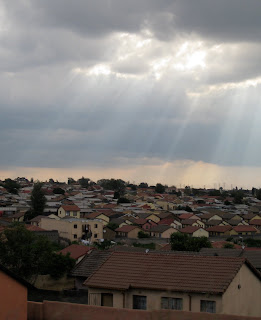

View of Soweto
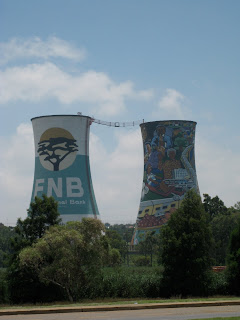
During apartheid, pollution from energy sources was released in the black neighborhoods while the residents of Soweto lacked electricity. When energy providers finally serviced Soweto, they were built outside of the township. The useless reactors now serve as a reminder of not only the apartheid legacy, but environmental racism

The infamous hostels - "housing" for migrant workers mining gold and diamonds


Hector Pieterson Museum in Soweto

Our adopted family

Trashcan lid used by students as a shield in the '76 uprising

Johannesburg newspaper from February 2010

Nelson Mandela's home
8115 Orlando Street, Soweto
Johannesburg
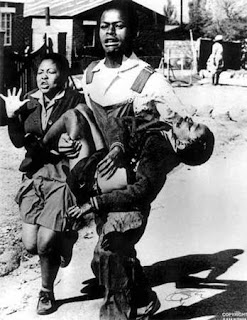
Hector Pieterson - Soweto Student Uprising in 1976

Saturday, May 15, 2010

"A Skeptic's View on Child Sponsorship "

We have all seen the commercials with a small, third-world child
in the arms of a nice white person...
most of us brace for the monetary "ask" that inevitably comes at the end
So, is it really working?


An interesting article written by a friend witnessing the effects of sponsorship first-hand in Rwanda:
A Skeptic's View on Child Sponsorship

Friday, May 7, 2010

Skins and Schools


Bushmen skins were openly sold in Botswana until the 1960s. One could decorate their home with African souvenirs that included pottery, traditional drums or the very skin of the Batswana indigenous population. Two generations later, the children of the Bushmen are no longer sold, just stolen.

Our group was invited to meet Bushmen and then participate in some activities with some of the last preservers of this mighty culture. Our time together revealed a highly complex system; for example, the trans-dance, medicinal walk and cave paintings testify to a culture innovative enough to leave a mark that has endured for 26, 000 years! One morning, three women took us into the bush to share medical and survival skills that have been both preserved and celebrated. We were shown edible plants, techniques to avoid the African sun, and tracking methods. Epstein describes the health care practiced as one that rivals the often championed Western biomedical approach: "some African medicine does have scientifically measurable chemical activity. African healers were among the first to develop the technique of smallpox inoculation, for example, and used quinine to cure malaria long before Europeans did." It is evident that not only has trust been established between the indigenous people and the land, but that they posses an enviable understanding of the intimate relationship between the environment and one's lifestyle. Sadly, this balance has never known perfect harmony, it is constantly being threatened by outsiders.


The tragedy of the Bushmen is currently relapsing. Western schooling has been rendered mandatory and consequently legalizes the forceful removal of Bushmen children. Traditional education has now been rendered worthless. The flaws in this process make this type of activity criminal; while education is a human right, this pedagogy kidnaps children and sanitizes them of their precious history. I believe some form a standard education is needed in order to protect the Bushmen; if they are educated on their civil rights, they cannot be further exploited. Ironically, this "enlightened" education is not one of liberation, but further oppression.

Why bus the children over 100 km from their established familial and communal roots? Why not blend the curriculum with traditional and modern teaching? What consequences should they brace for as the family structure is being ripped apart? Have the psychological damages done to these children been calculated? Please tell me how an eight-year-old copes as they encounter the loss of their family and a new sense of isolation!

Surely, our collective memory is not this short! Every country has their own shameful history with indigenous peoples. Native Americans in the United States were notoriously mistreated in the school system designed to assimilate them. The struggle of the Aboriginal people against forced education is the most recent event to highlight the self-determination of the people. It has been made famous by the true story, Follow the Rabbit Proof Fence. As the United States accounts for reservations mired by social problems and Australia fights over what day to nationally apologize, I wonder who will hold the government of Botswana accountable?

As the African "singe story" is incessantly exported is one of underdevelopment and poverty, it is predictable that the government of Botswana is trying to sanitize their modern nation-state from a culture labeled "primitive;" but how many "stolen generations" will we allow?


_______

To take action:
Take the pledge and add to the Sea of Hands Project
Australians for Native Title and Reconciliation, ANTaR
ANTaR's Issues and Campaigns

Resources:
Time magazine explains the "Stolen Generation"
Apology Speech of Kevin Rudd (Australia)